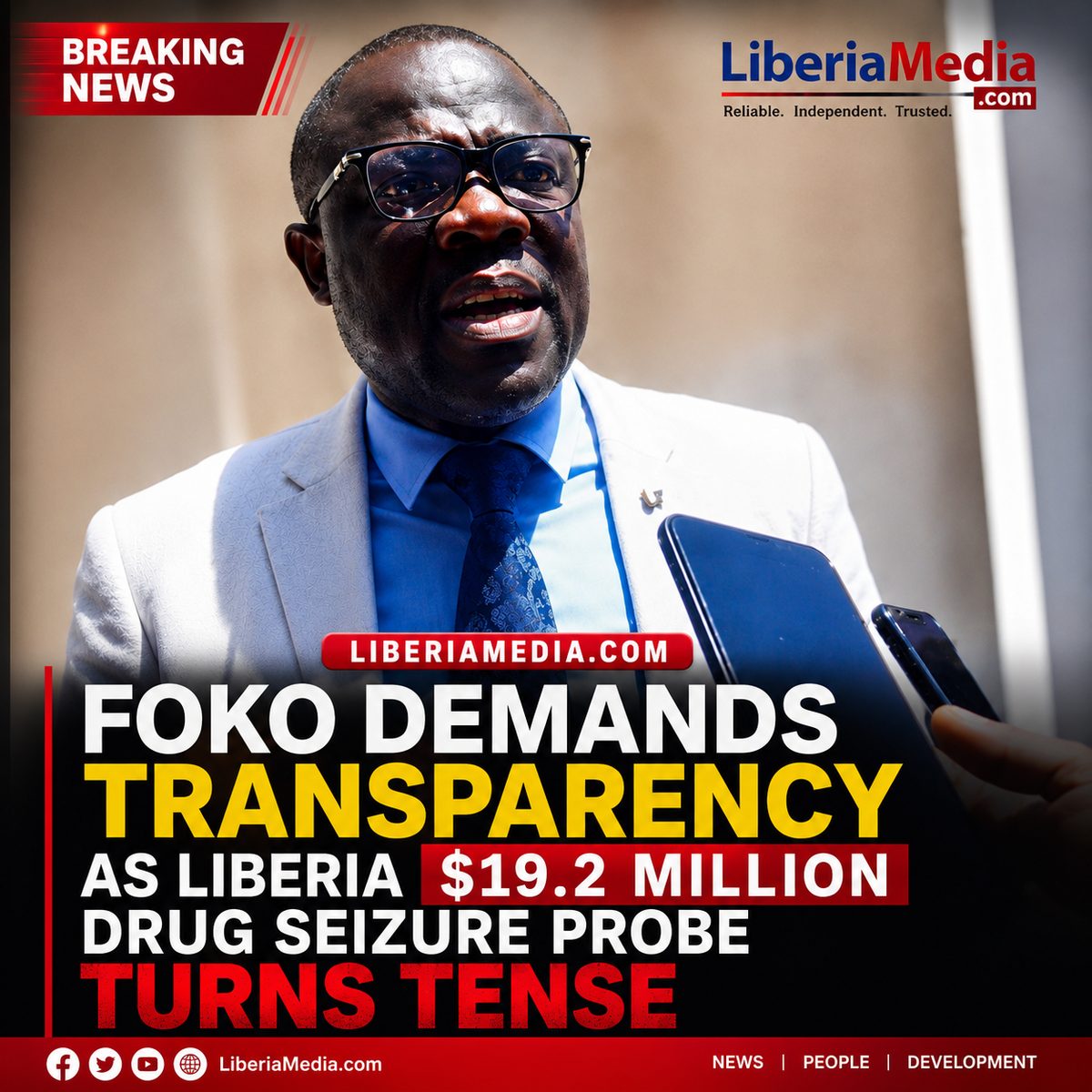
Monrovia, Liberia — Representative Frank Saah Foko is demanding answers. The Montserrado County District #9 lawmaker has sharpened his criticism of how authorities are handling the Liberia $19.2 million drug seizure case. Specifically, he accuses House leadership of shielding the process from public view after officials pushed lawmakers into a closed-door session on the matter.
What Happened in the Liberia $19.2 Million Drug Seizure
Security agencies intercepted roughly 237.6 kilograms of cocaine at the Roberts International Airport (RIA) cargo terminal. The shipment carries an estimated street value of US$19.2 million. As a result, Liberian authorities now call it one of the largest narcotics busts in the country’s history. Reportedly, the drugs were headed for Europe.
Naturally, the size of the seizure raised hard questions fast. How did a shipment that large move through one of Liberia’s most secure checkpoints? So far, officials haven’t fully answered that.
Because the bust reached such a large scale, and because it appeared to have international ties, Liberia’s National Security Council elevated it to a Joint National Security Investigation. Today, the Liberia Drug Enforcement Agency (LDEA) and Liberia National Police lead that effort. In addition, they’re getting support from the National Security Agency, the Financial Intelligence Agency, the Liberia Immigration Service, Customs, Airport Security, and the Ministry of Justice. For context, the United Nations Office on Drugs and Crime tracks how West African trafficking routes like this one tend to operate.
Lawmakers Summon Officials, Then Close the Doors
On June 16, 2026, the House of Representatives summoned LDEA leadership, RIA management, the Ministry of Justice, and Customs authorities. Lawmakers wanted a public briefing on the case. They also wanted the names of six suspected traffickers already in custody. Initially, organizers planned to keep the hearing open.
However, that changed fast. Minister of Justice and Attorney General Cllr. N. Oswald Tweh, Sr. asked for parts of the briefing to move into executive session. He cited the sensitivity of intelligence shared through international cooperation. He also pointed to Liberia’s limited capacity to manage certain disclosures. In response, lawmakers voted to go behind closed doors, and the House split immediately.
Representative Moima Briggs Mensah of Bong County District #6 walked out. She said she couldn’t discuss the matter privately because Liberians deserve to know what’s happening. Similarly, Foko walked out — but he went further. He accused Speaker Richard Nagbe Koon of having a personal connection to the case, and he suggested the move to secrecy was no accident.
“The House of Representatives should conduct its oversight responsibilities in an open and transparent manner, especially on matters of significant public interest such as the US$19 million drug seizure,” Foko said. Furthermore, he argued the executive session itself raised fresh questions about whose interests it was protecting.
Pressure Builds From Both Sides
Foko isn’t alone in this fight. Montserrado County Senator Abraham Darius Dillon has also pressed the LDEA to name the “persons of interest” it’s reportedly withholding. He’s warned that if the agency stays quiet, he’ll bring the matter before the Senate to force answers. Likewise, Dillon and Economic Freedom Fighters of Liberia Commander-in-Chief Emmanuel Gongquoi want President Joseph N. Boakai to act directly, since they believe accountability has to start at the top.
Meanwhile, former Foreign Minister Ambassador Dee-Maxwell Saah Kemayah, Sr. has weighed in too. He called the continued silence damaging to public trust. He also described the seizure’s scale as a national emergency that demands full openness.
On the other hand, not everyone agrees on this approach. District #8 Representative Prince Toles, Liberia Broadcasting System Director General Eugene Faghon, and presidential Political Advisor MacDella Cooper are urging patience instead. They warn that early disclosure could compromise an active, transnational investigation. It could also tip off suspects who remain at large. For example, Transparency International notes that this same tension shows up in major drug cases worldwide, where investigators must balance public accountability against operational secrecy.
The Liberia $19.2 Million Drug Seizure: A Test for Liberia’s Institutions
Ultimately, this dispute reflects a deeper pattern in Liberia’s governance. Often, the public’s right to know clashes with the operational need to protect an active investigation. Critics point to history here, too. Liberia has seen high-profile cases open with bold announcements and end with little follow-through. As a result, that track record breeds suspicion whenever officials ask for confidentiality now.
So far, the LDEA confirms several persons of interest are already in custody. Still, it hasn’t released their identities, and it hasn’t explained how the shipment cleared airport security either. Meanwhile, Foko, Dillon, and other lawmakers keep demanding answers, even as the Justice Ministry keeps holding firm on limiting disclosures. Consequently, the standoff over the Liberia $19.2 million drug seizure looks set to remain a defining test of transparency for the Boakai administration in the weeks ahead.
For now, the LDEA and the Joint National Security Investigation team say the case remains active. More updates are expected as the probe continues.
Read more Liberian news on LiberiaMedia.com | Visit our homepage for the latest updates