By Randall Saye | LiberiaMedia.com | June 24, 2026
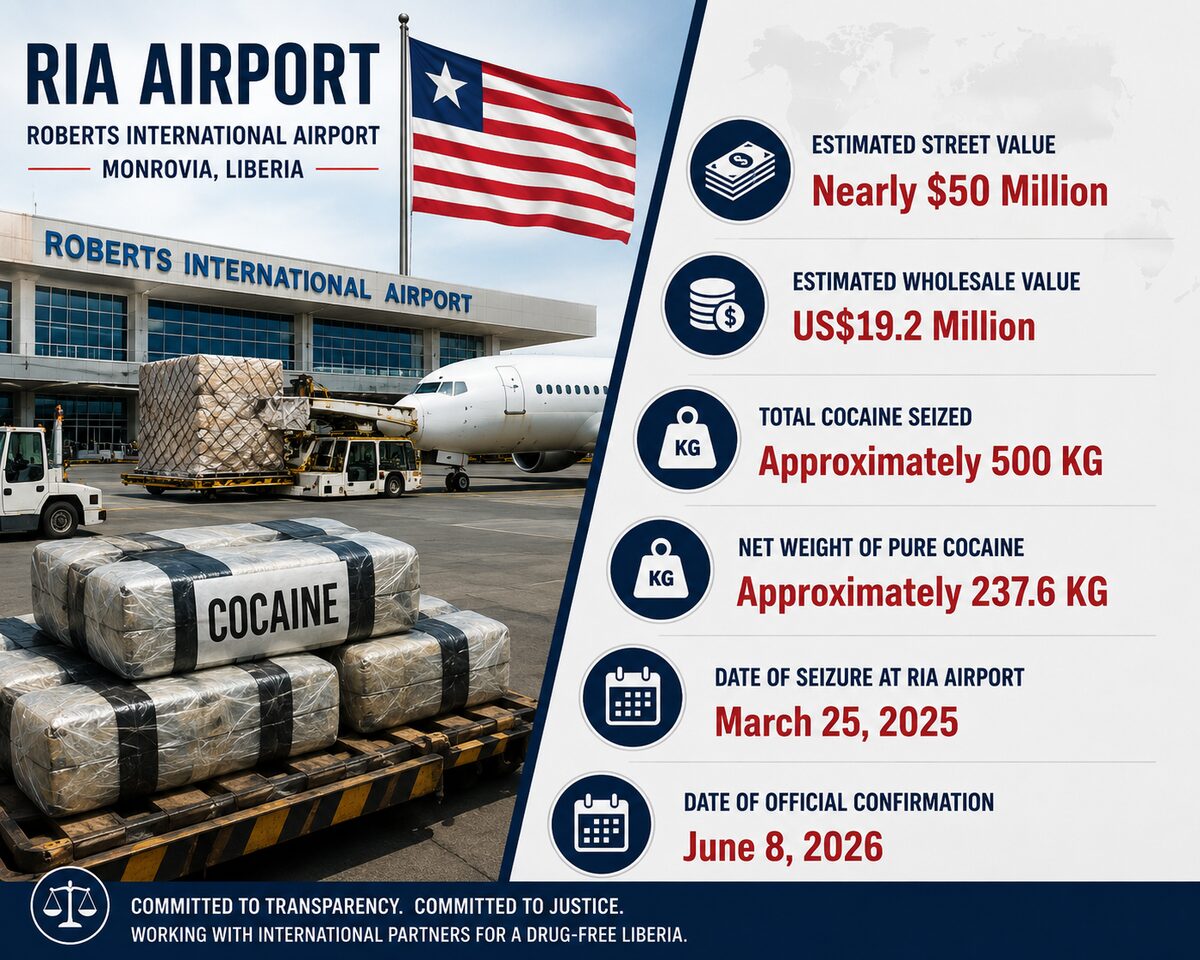
The Liberia cocaine seizure RIA security authorities conducted on June 8, 2026 — involving approximately 237.6 kilograms of cocaine valued at US$19.2 million — has sent shockwaves through the country’s political and security landscape. But beyond the headlines, the case raises deeper and more uncomfortable questions about West Africa’s growing vulnerability to transnational drug trafficking networks, and what it truly takes to dismantle them. According to the United Nations Office on Drugs and Crime (UNODC), West Africa has become one of the most significant cocaine transit corridors in the world — and Liberia’s latest bust is a stark reminder of that reality.
How the Liberia Cocaine Seizure at RIA Unfolded
The Liberia Drug Enforcement Agency (LDEA) confirmed that the consignment was transported to RIA on June 5, 2026, by an individual identified as Emmanuel Zeon, who departed shortly after delivering the cargo to the airport warehouse for export via Brussels Airlines. Authorities intercepted the shipment three days later, triggering one of the largest drug busts in the country’s recent history.
The National Security Council subsequently elevated the matter to a Joint National Security Investigation involving the LDEA, Liberia National Police (LNP), the National Security Agency (NSA), the Financial Intelligence Agency (FIA), Liberia Immigration Service, and customs authorities. The breadth of agencies now involved signals just how seriously officials are treating what they describe as a wide-reaching trafficking enterprise.
Suspension, Scrutiny, and Unanswered Questions
On June 22, 2026, President Joseph Nyuma Boakai suspended Peter Malcolm King from the Board of Directors of the National Oil Company of Liberia (NOCAL), following a briefing from the Ministry of Justice and the Joint Investigative Task Force. King is also the CEO of Global Logistics Services (GLS) Menzies Warehouse at RIA — the company whose warehouse sat at the center of the Liberia cocaine seizure RIA investigators are now probing.
The government stressed that the suspension does not constitute a finding of guilt, describing it as a precautionary administrative measure to protect the integrity of the ongoing investigation. GLS itself welcomed the move, with King accepting it “with respect and gratitude,” according to a company statement.
GLS further claimed it had flagged issues with the cargo before it could depart and that the shipment never actually left Liberia. The company publicly questioned why it would stop a cargo it had any interest in moving. The LDEA confirmed the seizure occurred before the cargo was exported.
Montserrado County Senators Abraham Darius Dillon and Saah Joseph have since petitioned the Liberian Senate to recommend the temporary suspension of GLS Menzies’ cargo-handling concession at RIA. GLS Menzies General Manager Paul J. King and Security Manager Philip Yeoh have also been named among persons of interest by the Joint Task Force — designations that authorities stress do not imply guilt.
Liberia Cocaine Seizure RIA Exposes West Africa’s Drug Transit Problem
The RIA cocaine bust does not exist in isolation. West Africa has increasingly been identified by international drug enforcement agencies as a key transit corridor for cocaine moving from South America to Europe. The region’s porous borders, under-resourced customs infrastructure, and established shipping lanes have made it an attractive hub for transnational trafficking networks.
Liberia’s exposure is especially acute given its role as a cargo hub in the sub-region. Roberts International Airport handles significant freight volumes, and the Freeport of Monrovia connects the country directly to global shipping routes. Civil society group STAND (Solidarity and Trust for a New Day) has pointed to allegations — which it emphasizes remain unverified — of a trafficking network involving warehouse facilities at the Freeport and freight-forwarding operations extending to RIA.
Legal advocates tracking the case have argued that dismantling such operations requires going beyond the point of seizure. Advocate Martin K. N. Kollie has publicly called on investigators to examine corporate ownership structures, financial transaction records, communications logs, and the broader operational networks surrounding logistics operators — not just individuals physically connected to the shipment.
What Real Accountability Must Look Like
The LDEA has vowed the Liberia cocaine seizure RIA probe will not end at the airport. The agency pledged to pursue financiers, facilitators, logistics coordinators, and any international actors connected to the consignment, warning that no individual — regardless of position, status, or institutional connection — will be shielded from the full weight of the law.
Civil society groups have echoed that call, emphasizing that accountability must be consistent. Lower-level operatives, several of whom are already in custody, should not bear the full legal weight while those further up the chain face only administrative suspensions. STAND has called for a transparent, internationally supported investigation to ensure the process remains free from political interference.
President Boakai has repeatedly pledged a zero-tolerance stance against drug trafficking. How far the current investigation reaches — and who it ultimately holds accountable — will be the true measure of that commitment.
For Liberia, the stakes extend well beyond its borders. The country’s international reputation, its relationships with key partners including the United States and the European Union, and its standing as a credible aviation and trade hub all hang in the balance. Winning this fight will require more than suspensions. It demands full transparency, prosecutorial courage, and institutional accountability that leaves no powerful actor untouched.
LiberiaMedia.com will continue to follow all developments in the RIA cocaine investigation. For the latest Liberian news, visit LiberiaMedia.com.