
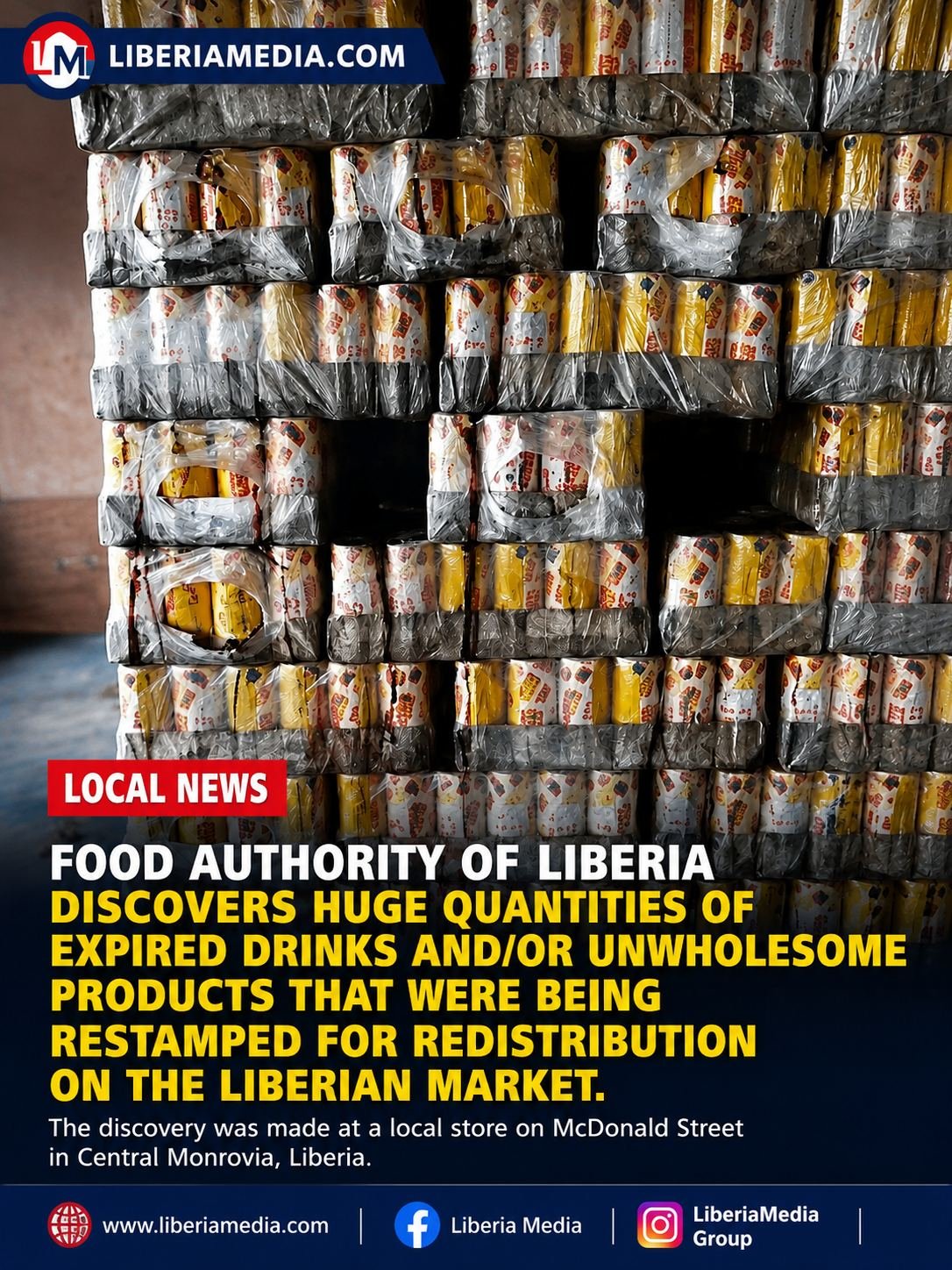
Monrovia, Liberia — Video and photo evidence shared directly by the Food Authority of Liberia (FAL) shows what the agency describes as a large-scale operation to restamp expired drinks and other unwholesome products for resale on the Liberian market. The footage, filmed at a store on McDonald Street in Central Monrovia, shows row after row of canned and bottled beverages stacked from floor to ceiling — product that regulators say had passed its expiration date before being relabeled and prepared for redistribution to unsuspecting consumers.
The Food Authority’s own social media page posted the video, which quickly spread across Liberian social media and was reshared by outlets such as Verity Online News, drawing thousands of reactions, shares, and comments within hours. That the images originate from the regulator’s own account — rather than from an anonymous tip or a rumor circulating on WhatsApp — gives this story a level of official backing that similar reports have not always had.
What the Footage Shows
The video, filmed inside the McDonald Street store, pans across dense rows of canned beverages arranged on tables and stacked against a wall, with what appear to be additional pallets and cartons piled behind them. A separate clip, shared through Reels, shows tightly wrapped cartons stacked several rows high, consistent with bulk storage of beverages awaiting distribution. Together, the images paint a picture of a substantial quantity of goods — not a handful of stray items, but what looks like an organized stockpile.
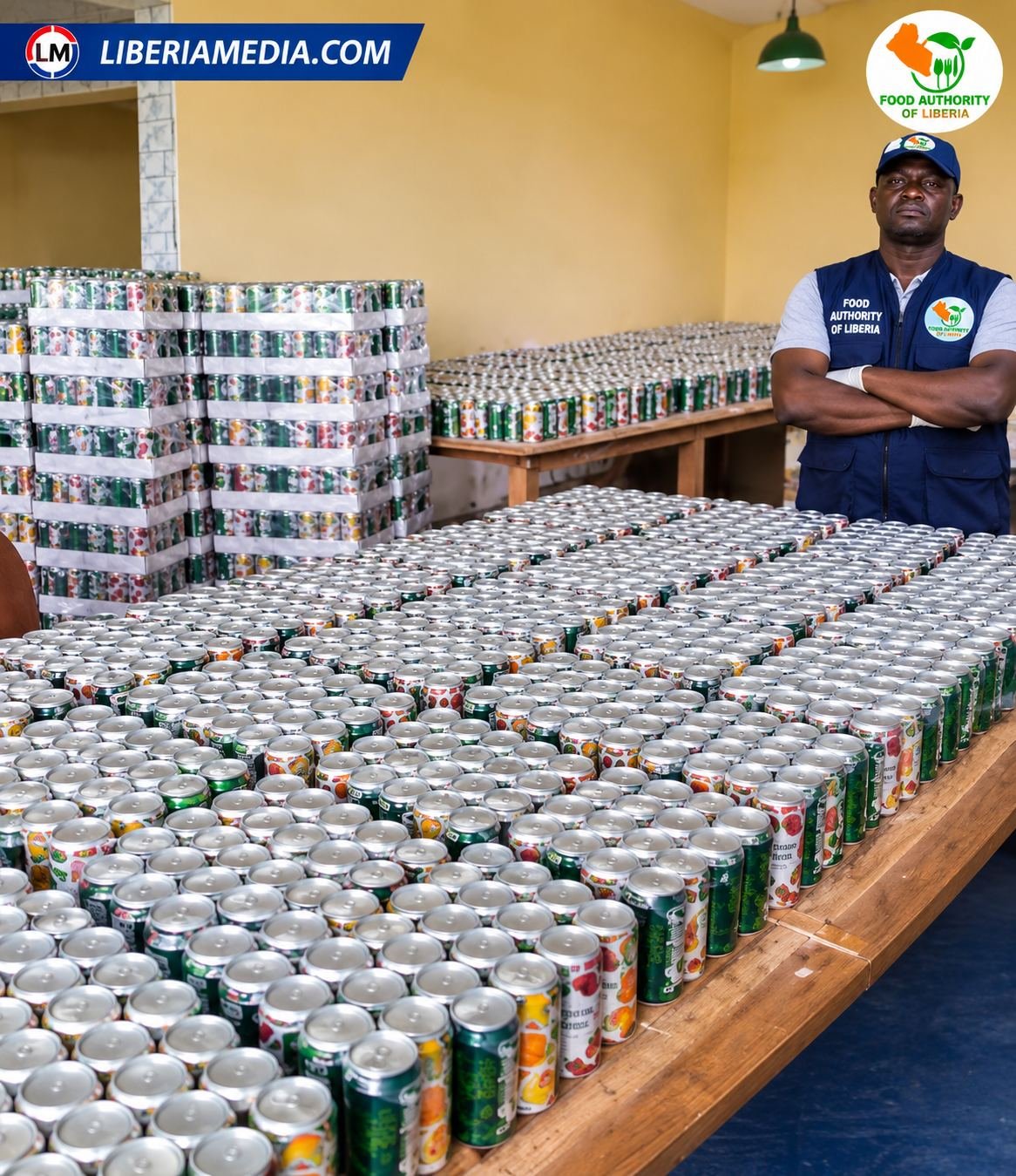
For consumers scrolling past this footage, the takeaway is straightforward: expired products in Liberia are not always destroyed once they pass their shelf life. In some cases, according to the Food Authority’s findings, they are relabeled and sent right back into circulation.
Why Restamping Expired Products Is So Dangerous
Food and beverage expiration dates exist for a reason. Once a product passes that date, manufacturers can no longer guarantee its safety, its nutritional value, or even its basic taste and quality. Restamping expired goods with a false, later date does not restore any of that — it simply hides the risk from the person buying the product.
This is where the Food Authority of Liberia’s mandate becomes central to the story. Established under the Food and Feed Quality and Safety Law and led by Director General Precellia Cherue, the Authority is responsible for inspecting food and beverage businesses across Liberia, certifying that products on the market are safe, and shutting down operations that violate food safety standards. It also chairs the National Food Safety Coordination Committee, which is meant to align food safety enforcement across different government agencies. Operating from its headquarters on the Capitol Bye-Pass in Monrovia, the Authority has positioned itself as the primary line of defense between unsafe products and Liberian consumers.
The McDonald Street discovery, if it plays out as the video evidence suggests, is exactly the kind of enforcement action that mandate exists for.
A Recurring Challenge for Liberia’s Food Market
This is not the first time Liberian authorities have uncovered schemes involving expired goods being relabeled for resale. Over the past several years, various government bodies — including the Ministry of Commerce and Industry and other regulatory agencies — have reported similar discoveries, ranging from restamped warehouse inventory to expired rice and contaminated fish pulled from local markets. Each case has followed a familiar pattern: a dramatic discovery, public outrage, and a call for stronger enforcement.
What makes the current moment different is the growing visibility of these enforcement actions. Liberia has recently seen expanded investment in food safety infrastructure, including new laboratory facilities meant to strengthen product testing nationwide, alongside ongoing efforts to modernize the country’s food safety laws. Public regulators sharing direct video evidence, as the Food Authority did in this case, is itself part of that shift — it puts pressure on businesses by making violations visible to the public in real time, rather than settling matters quietly behind closed doors.
What Consumers Can Do
While regulators carry the primary responsibility for keeping expired and restamped products off store shelves, there are steps ordinary shoppers in Monrovia and across Liberia can take to protect themselves:
- Check expiration dates carefully. Look for signs of tampering, such as uneven stamping, smudged ink, or labels that appear newer than the surrounding packaging.
- Inspect packaging condition. Rust, dents, swelling cans, or unusual discoloration can be signs a product has been stored far longer than its label suggests.
- Buy from reputable retailers. Established supermarkets and stores with consistent inventory turnover are generally lower-risk than shops known for unusually low prices on name-brand goods.
- Report suspicious products. The Food Authority of Liberia can be reached at +231 88 828 6017 or +231 88 620 1218 for consumers who want to report suspected expired or mislabeled products.
The Road Ahead
The footage from McDonald Street has already done what enforcement alone often cannot: it has put the issue of restamped expired goods back in front of the Liberian public, forcing a conversation about accountability. The next steps will matter just as much as the discovery itself. Liberians will be watching to see whether the products shown in the video are properly destroyed, whether the business involved faces meaningful consequences, and whether this case becomes another turning point for food safety enforcement in Liberia — or another headline that fades once the news cycle moves on.
For now, the Food Authority of Liberia’s willingness to document and publicize this case marks a step toward greater transparency in how Liberia protects its food and beverage supply. Whether that transparency translates into lasting change is the question that will define what happens next.
This article is based on video and photo evidence shared publicly by the Food Authority of Liberia and reporting by Emmanuel M. Kangar Jr. Readers with additional information about this case are encouraged to contact the Food Authority of Liberia directly.
nkjdfdeposjystpelkxwlxyijsomqn