

Walk into a classroom in Sinkor today and you might see a smart board where a chalkboard used to be. Walk into one in rural Maryland County, and you might find a teacher pulling up a lesson plan on a solar-charged tablet instead of a stack of worn textbooks. That contrast — and the effort to close it — is the story of EdTech Liberia right now: a slow but real shift from rote memorization toward something that actually looks like 21st-century learning.
For most of Liberia’s history, education has leaned hard on repetition — copy the notes, recite the facts, pass the test. It worked well enough when there was nothing else to work with. But a growing number of public-private partnerships are putting tablets, interactive software, and dedicated computer labs into schools that never had them before, and it’s changing what a school day actually looks like for thousands of students.
What’s Actually Changing in the Classroom
In Monrovia, schools like J.J. Roberts United Methodist School and William V.S. Tubman High School have started building smart boards and dedicated IT periods into their weekly schedule. That’s not just a hardware upgrade — it’s a shift in how students are taught to think. Instead of memorizing a list of dates, students are learning to research a topic, cross-check a source, and put together a document in Word or a spreadsheet in Excel. Those are the exact skills employers expect now, whether the job is in Monrovia or overseas.
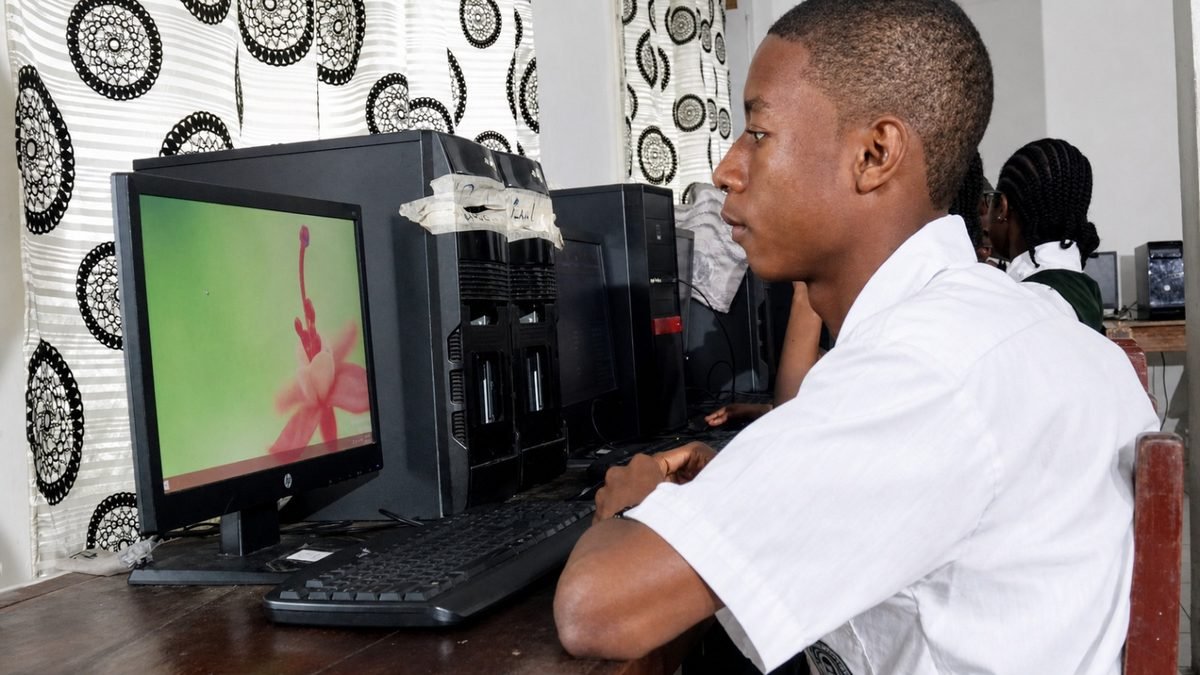
Rural Liberia is catching up too, even if the road there looks different. Bridge Liberia, working through the government’s Liberian Education Advancement Program, has spent years equipping teachers with tablets loaded with structured lesson plans, so a student in Maryland County has a real shot at the same quality of instruction as a student in Montserrado. More recently, a new push called School Connect — launched by the Liberia Telecommunications Authority alongside the Ministry of Education — is rolling out satellite internet and internet kits to 156 public high schools, aiming to shrink the long-standing urban-rural gap in digital access.
The Hard Part: Power, Data, and Training
None of this works without electricity, and that’s where the whole picture gets complicated. Reliable power is still out of reach for a lot of the country, and data costs eat into family budgets fast enough that sustained digital learning becomes a luxury rather than a habit. Education advocates have been pushing for a national policy that subsidizes data for approved learning platforms and funds solar-powered computer hubs in areas the grid doesn’t reach — infrastructure fixes that would do more for EdTech in Liberia than another shipment of tablets ever could.
Even where the tech shows up, it’s only as good as the person using it. As one local principal put it, a computer is just a box without a trained teacher to guide the student through it. Liberia’s Ministry of Education has acknowledged as much: officials involved in the School Connect rollout have been careful to frame internet access as a starting point, not a finished solution, stressing that impact depends entirely on how effectively teachers actually use the tools they’re handed. That’s a fair warning — connectivity without training just becomes an expensive way to browse the internet.
Digital Literacy Is the Real Goal, Not Just Devices
The bigger shift EdTech Liberia is chasing isn’t really about hardware at all — it’s about building a habit of curiosity and critical thinking around digital tools. Students are being taught to navigate the internet safely, judge whether a source is trustworthy, and work together on shared documents and projects. Those habits matter more than any single app, because they’re what actually let Liberian students compete for opportunities that used to be out of reach.
Local tech developers are helping close the gap in their own way, building content that actually reflects the Liberian context instead of importing something generic. Early childhood literacy apps built around local languages, for instance, are proving to be a genuine game-changer in the interior, where English-only materials have always been a barrier before a child even gets to the lesson itself.
Building a Pipeline, Not Just a Program
None of this holds together without a plan that runs the full length of a student’s education, not just the early grades. The University of Liberia and Stella Maris Polytechnic have both been expanding their computer science departments to meet a labor market that’s asking for tech-literate graduates more urgently every year. Connect that to the digital push happening in primary and secondary schools, and Liberia starts to look less like a country playing catch-up and more like one building an actual pipeline — and a legitimate case for itself as a future tech hub in West Africa.
Getting there means treating digital literacy as a core subject, the same way reading and writing are treated, instead of an “extra” that gets cut when budgets tighten. That’s a mindset shift as much as a funding one.
What It Will Take to Make This Stick
Sustaining any of this long-term is going to take real coordination between government, the private sector, and international partners — not just a good pilot program that fades once the funding cycle ends. Reliable power and affordable internet access are the foundation everything else sits on. Right behind that is ongoing training for teachers, because a school full of tablets means nothing without educators who know how to put them to work.
The classrooms leading this shift prove it’s worth the investment — the energy in a well-run IT period is obvious the moment you walk in. A tablet or a smart board is just a tool. The real change happens when a prepared teacher picks it up and uses it to open a door a textbook alone never could. Visit our Education section for more on how Liberian schools are evolving, and see the Liberian Observer’s coverage of the School Connect rollout for a closer look at how the country’s digital divide is being addressed county by county. For more on how public-private partnerships are shaping Liberian classrooms, Bridge Liberia’s program overview is also worth a read, and LiberiaMedia.com will keep following this story as it develops.
[…] Embracing a Modern Future Why Liberian Journalism Still Matters in the Age of Facebook Rumors EdTech Liberia: How Classrooms Across the Country Are Going Digital August 4, […]